
2026 Best Dry Type Transformer for Global Buyers
Choosing the 2026 best dry type transformer requires more than comparing prices and catalog ratings. Global buyers need dependable performance, documented testing, and practical support after delivery. A suitable unit should match the project’s voltage, capacity, frequency, insulation class, cooling method, and installation environment.
Real-world selection often begins with site details. A dusty factory may need stronger enclosure protection and easier cleaning access. A high-altitude installation may require derating because thinner air reduces cooling efficiency. Hospitals, data centers, and commercial buildings may also demand low noise and stable voltage regulation. Cast resin designs can offer strong resistance to moisture and fire risks, but their cost and repair requirements deserve careful review. Air-insulated models may simplify maintenance, although ventilation quality becomes more important.
Reliable manufacturers should provide routine test reports, temperature-rise data, efficiency figures, and clear warranty terms. Buyers should check compliance with applicable IEC or regional standards instead of trusting broad marketing claims. Factory inspection, sample review, and communication with experienced engineers can reveal problems before shipment. Small details matter, including terminal layout, cable clearance, lifting points, spare parts, and delivery packaging.
No ranking fits every project. A powerful transformer may be unsuitable for a compact building. A low-cost model may create higher operating expenses later. Even experienced buyers can overlook future load growth. This guide compares leading options through performance, safety, serviceability, lifecycle value, and supplier reliability, while recognizing that local conditions still require professional verification.
What Is a Dry Type Transformer?
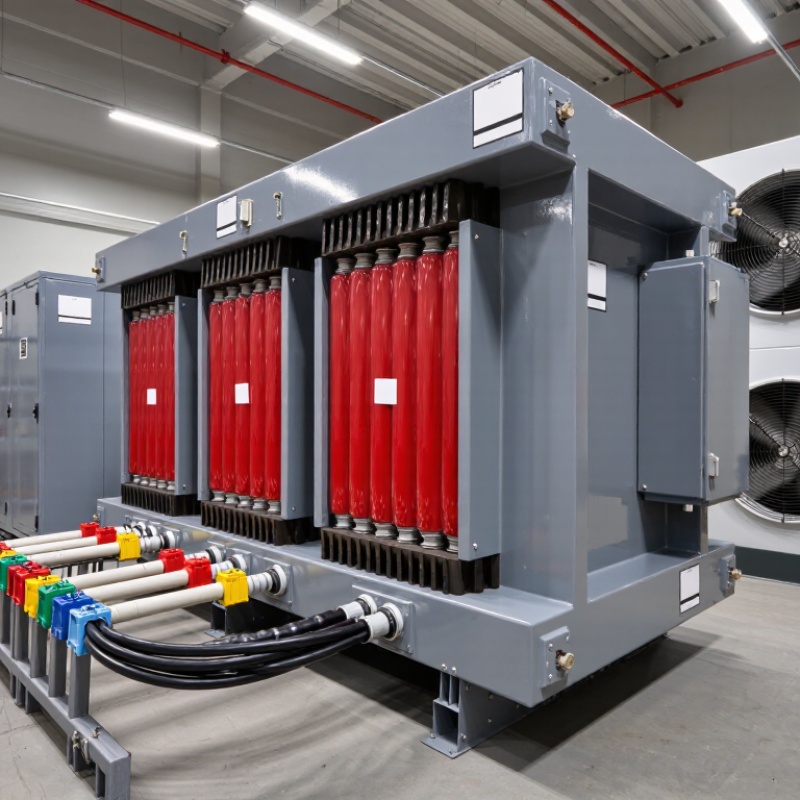
A dry type transformer changes electrical voltage without using liquid insulation. Its windings and core operate in air or solid insulating materials. Unlike oil-filled equipment, it has no transformer oil that can leak. This makes it practical for buildings, tunnels, hospitals, factories, and indoor substations.
The magnetic core transfers energy through electromagnetic induction. Copper or aluminum windings receive one voltage and deliver another. Solid resin, varnish, or layered insulation separates energized parts. Many units use cast-resin construction, while others use ventilated insulation systems. Selection depends on load, fire requirements, humidity, altitude, noise limits, and available space. A 1000 kVA unit can behave very differently in a hot, dusty room.
Safety still requires engineering discipline. Dry type does not mean risk-free. Dust can reduce cooling, and blocked air passages can raise winding temperature. During field inspections, technicians should check terminals, insulation surfaces, cooling fans, vibration, and unusual odors. I have seen “low-maintenance” equipment fail after simple ventilation neglect. That phrase deserves skepticism.
Buyers should review temperature-rise data, short-circuit strength, efficiency, sound levels, enclosure protection, and applicable local standards. Ask for routine test reports and installation clearances. A transformer sized only from today’s load may become restrictive later. Yet oversizing also increases cost and no-load losses. The right choice is not always the largest one.
2026 Best Dry Type Transformer for Global Buyers - What Is a Dry Type Transformer?
| Evaluation Dimension | Typical Data or Specification | What Global Buyers Should Know |
|---|---|---|
| Definition | A transformer that uses air or another gas as its insulation and cooling medium instead of liquid insulation. | Dry type transformers do not contain mineral oil or other liquid dielectric fluid in the active insulation system, making them suitable for many indoor and environmentally sensitive installations. |
| Common Transformer Types | Cast-resin VPI Air-core Air-cooled | Cast-resin designs provide sealed windings with strong resistance to moisture and contamination. VPI designs use vacuum pressure impregnation and are commonly selected for industrial and commercial applications. |
| Typical Capacity Range | Approximately 25 kVA to 20,000 kVA, depending on design and voltage class. | The practical range varies by manufacturer, cooling method, enclosure, insulation system, and project requirements. Larger capacities may require special transport and installation planning. |
| Typical Primary Voltage | Common medium-voltage ratings include 3.3 kV, 6.6 kV, 10 kV, 11 kV, 13.8 kV, and 15 kV. | The primary voltage must match the local utility or upstream distribution system. Regional grid voltage, frequency, insulation level, and connection rules should be confirmed before ordering. |
| Typical Secondary Voltage | Common low-voltage outputs include 400 V, 415 V, 480 V, and 600 V. | Secondary voltage should be selected according to the downstream equipment, local electrical code, motor starting requirements, and allowable voltage drop. |
| Frequency | 50 Hz or 60 Hz. | A transformer designed for 50 Hz should not automatically be used on a 60 Hz system, or vice versa. Frequency must be stated clearly in the technical specification. |
| Cooling Method | AN: air natural; AF: forced air using fans. | Natural-air cooling is simpler and quieter. Forced-air cooling can increase available capacity but requires fan controls, auxiliary power, ventilation, and maintenance access. |
| Insulation System | Cast-resin or impregnated insulation systems, commonly designed for thermal classes such as Class F or Class H. | The insulation class indicates the thermal capability of the insulation system. Actual temperature rise and service life also depend on loading, ambient temperature, ventilation, and harmonics. |
| Temperature Rise | Common design values include 80 K, 100 K, or 120 K, subject to the applicable standard and design. | A lower temperature rise can improve efficiency, noise performance, and service life, but may increase initial size and cost. The specified value should be checked against the project duty cycle. |
| Efficiency | Typically above 97% at rated load for many medium-size distribution transformers; exact efficiency varies with capacity and design. | Purchase decisions should consider both no-load losses and load losses. A higher-efficiency transformer can reduce lifetime electricity costs, especially in continuously energized facilities. |
| Impedance | Often approximately 4% to 8% for distribution-class units, depending on rating and voltage. | Impedance affects fault current, voltage regulation, motor starting, and parallel operation. The specified value must coordinate with upstream protection and downstream short-circuit ratings. |
| Insulation Level | Specified by power-frequency withstand and lightning impulse withstand levels according to the system voltage and applicable standard. | Insulation coordination is essential for medium-voltage systems. Buyers should request the rated insulation level, impulse withstand level, and test voltage in the technical schedule. |
| Fire and Environmental Profile | No liquid oil spill risk; generally reduced liquid-fuel fire risk compared with oil-immersed transformers. | Dry type units are often preferred in buildings, tunnels, hospitals, data centers, schools, and environmentally sensitive locations. They still require appropriate electrical clearances and fire protection. |
| Installation Location | Indoor rooms, electrical substations, commercial buildings, industrial plants, renewable-energy facilities, and some outdoor enclosures. | Indoor installation requires adequate ventilation, access clearance, humidity control, and protection from dust, chemicals, water ingress, and condensation. Outdoor use normally requires a suitably rated enclosure. |
| Enclosure Protection | Selected according to the environment; common enclosure ratings include IP20, IP23, IP31, IP42, and IP54. | The required ingress protection depends on the installation area. Higher protection may reduce natural airflow, so thermal performance and ventilation must be checked together. |
| Noise Level | Often approximately 50 dB to 75 dB at rated operation, depending on capacity, core design, enclosure, and cooling mode. | Noise limits should be defined at a specified distance and operating condition. Low-noise designs may be necessary for offices, residential buildings, hospitals, and other noise-sensitive sites. |
| Maintenance Requirements | Routine visual inspection, cleaning, ventilation checks, connection checks, temperature monitoring, and periodic electrical testing. | Maintenance is generally simpler than for liquid-filled units because there is no oil sampling or liquid-level monitoring. Dust accumulation and blocked ventilation can still cause overheating. |
| Protection and Monitoring | Typical options include temperature sensors, trip or alarm relays, cooling-fan controls, surge protection, and enclosure interlocks. | Protection should coordinate with the transformer rating, switchgear, grounding system, and facility automation system. Temperature monitoring is especially useful for variable or high-load applications. |
| Applicable Standards | IEC 60076-11, IEEE C57.12.01, and relevant national or regional electrical standards. | The required standard depends on the destination market and project contract. Buyers should specify the governing standard rather than assuming that one test certificate is accepted worldwide. |
| Factory Tests | Common tests include winding resistance, turns ratio, polarity or phase displacement, load loss, no-load loss, impedance, dielectric withstand, and partial discharge where specified. | A complete routine-test report supports quality verification. Type tests, special tests, seismic tests, sound tests, and harmonic-load evaluations may be required for particular projects. |
| Main Advantages | Low liquid-fire risk, simplified environmental management, indoor suitability, compact installation options, and reduced routine maintenance. | The best choice depends on total ownership cost, space, load profile, fire requirements, ambient conditions, noise limits, and local acceptance rules—not only on purchase price. |
| Main Limitations | Sensitive to dust and moisture, requires effective ventilation, may have higher initial cost, and can be affected by overload and harmonic heating. | Before purchase, confirm ambient temperature, altitude, humidity, pollution level, harmonic content, duty cycle, overload requirements, and available room dimensions. |
| Selection Checklist | Capacity, primary and secondary voltage, frequency, phase, vector group, impedance, insulation level, temperature rise, enclosure, cooling, standards, and accessories. | A complete datasheet reduces specification gaps and helps compare technically equivalent products from different markets without relying on brand-specific information. |
Note: The values shown are typical engineering ranges for preliminary comparison. Final ratings, test requirements, dimensions, weights, losses, and compliance details must be confirmed in the approved project datasheet and applicable standards.